
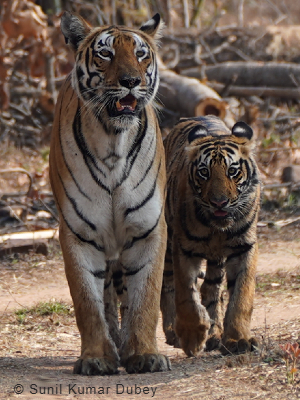
Royal Bengal tiger in Madhya Pradesh is believed to be the largest cat species in the subcontinent region of Asia. They are the national animal of India thus have special status at government and public levels. If we try to find out different regions of India, in terms of tiger population, we will notice that Central India region have the highest population share which indicates that here they find their ideal habitat, security and flourishing environment. They can easily be distinguished by their rufous yellow coat with black stripes pattern in their body. Every tiger have different stripe pattern through which they are identified. Here adult male can easily be distinguished from adult female by their large body size, broad thickset neck and large skull size. At Madhya Pradesh they are found in many population tiger reserves like Kanha tiger reserve, Bandhavgarh, Panna tiger reserve etc. While doing jeep safaris, they are mostly seen inside these protected areas. Basically they are shy by nature thus their sighting is not so easy and need efforts, tracking skills and also luck to some extent.
Although Central India region have highest concentration of Indian tiger population but still they can't be easily located. It is a protected animal thus mostly seen inside protected areas. Here in India, government have declared many critical tiger habitats as tiger reserves thus these declared tiger reserves are the best place to find them. For tiger photography, just try to visit such popular tiger reserves. At Madhya Pradesh, some of such popular national parks (part of tiger reserves) are listed in the below given table.
| BEST PLACES TO SEARCH | ||
| Kanha National Park | Bandhavgarh National Park | Pench National Park |
| Panna National Park | Satpura National Park | Sanjay Dubri Tiger reserve |
Wildlife safari guides shares their experience on tiger tracking. They says that if you visiting a popular tiger reserve, then we will have high probability to find tigers activity at dusk and dawn hours. Most of the jungle calls can be heard in these hours of a day.
Please check below given table to learn some vital details and characteristic features. For first time visitors, this concise and precised information will be very helpful to have basic understanding.
| Title | Details |
| Kingdom | Animalia |
| Phylum | Chordata |
| Sub-phylum | Vertebrata |
| Class | Mammalia |
| Order | Carnivora |
| Sub-order | Feliformia |
| Family | Felidae |
| Genus | Panthera |
| Species | Panthera tigris |
| Average Life Span | 10-15 Yrs. At enclosures and zoo, life span can be increased to 17-19 yrs. |
| Diet | Their main prey are medium to large size animals like spotted deer, Sambar deer, Nilgai, village cattle etc. In a single feed, they can eat 20-40 kg of meat. |
| Size | 08-10 Feet (from mouth to tail). |
| Weight | 70-260 kg. |
| IUCN Conservation Status | Endangered |
| Nature | Diurnal. They can be seen active in day and night. More active after sunset. |
| Gestation Period | 90-120 Days |
| Breeding Season | November to June is most active period but they can breed round the year. |
| Relationship | Usually seen solitary. Tigress often seen with cubs. During mating period, tiger and tigress can be seen together for few days. |
| Dietary | Carnivores |
| Local Name | Bagh, Sher |
 9202337070